

Rural vineyard management is a crucial aspect of producing quality wines that truly capture the essence of the land. At Curtis Family Vineyards, we believe that each bottle of wine tells a story of its origin — from the soil to the grape, and ultimately to the glass. This post aims to provide an insight into the intricate art of managing a vineyard in a rural setting, highlighting the dedication and passion that goes into every vine.
Rural Vineyard Management in McLaren Vale Setting the Foundation for Healthy Vine Growth
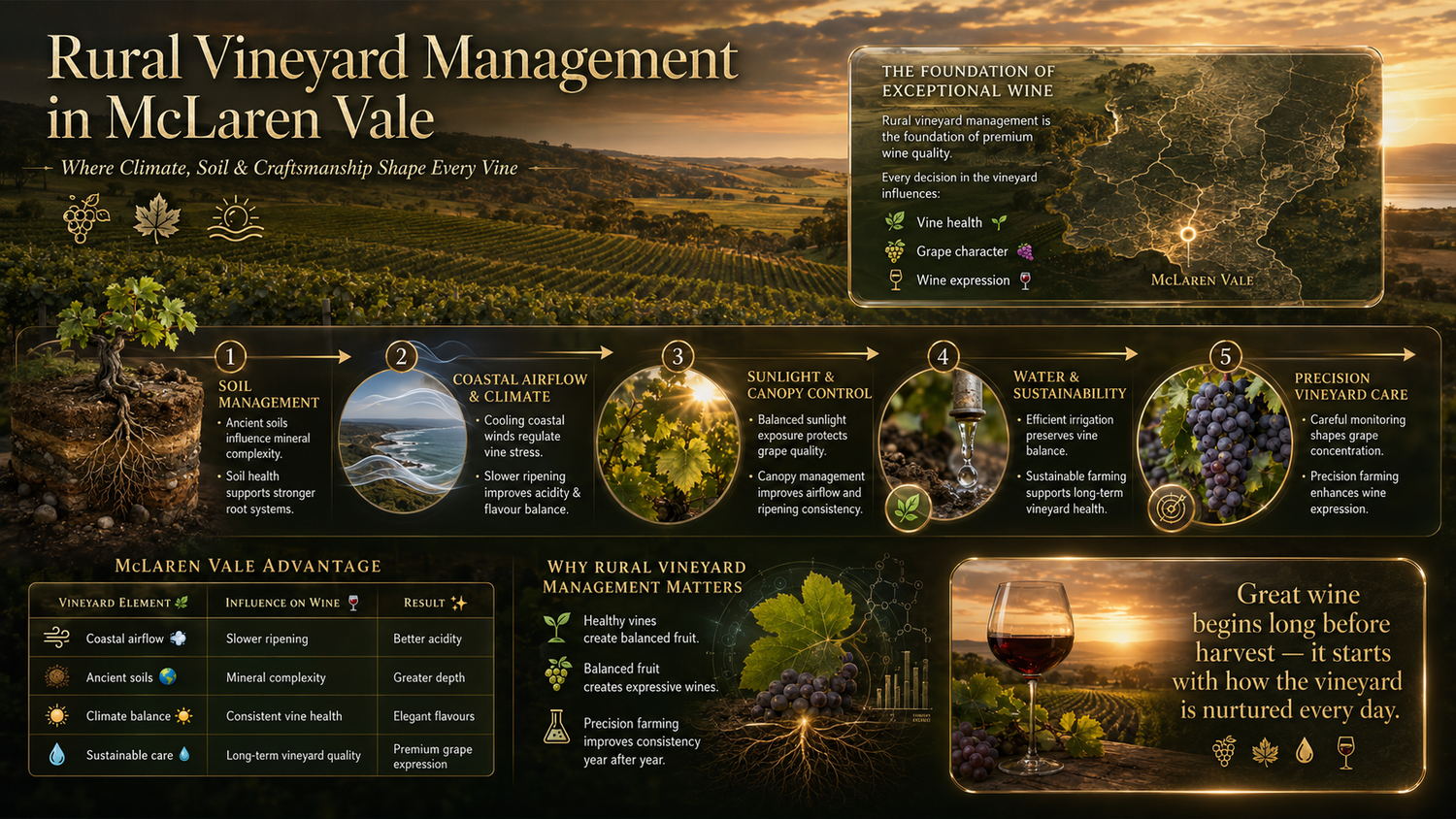
Rural Vineyard Management in McLaren Vale is more than just day to day vineyard care it is the quiet science behind consistently healthy vines and expressive wines. In a region known for its ancient soils and cooling coastal winds, every decision in the vineyard directly shapes grape quality long before harvest even begins.
McLaren Vale has long been recognised as one of Australia’s most diverse wine regions. Research from Australian viticulture studies highlights that vineyards closer to coastal airflow tend to develop slower ripening cycles, which often results in better natural acidity and more balanced flavour profiles. This makes rural vineyard management here both an art and a precise agricultural discipline.
Why McLaren Vale creates a unique vineyard environment
The region brings together a rare mix of natural factors that directly influence vine health:
- Ancient soils with high mineral diversity that support deep root development
- Cooling sea breezes from Gulf St Vincent that reduce heat stress on vines
- Low to moderate rainfall patterns requiring careful water planning
- Varied elevation and slope structures creating microclimates within short distances
These conditions mean that no two vineyard blocks behave the same way. Experienced vineyard managers often treat each block as its own ecosystem rather than applying a single approach across the estate.
The connection between environment and long term vine strength

Healthy vine growth in rural vineyard systems depends heavily on how well the vineyard responds to its natural environment rather than trying to control it completely. In McLaren Vale, long term vine performance is shaped by three critical environmental interactions:
- Soil and root interaction determining nutrient uptake and vine resilience
- Climate and canopy balance influencing grape ripening speed and sugar development
- Water availability and stress cycles affecting berry size and flavour concentration
For example, controlled water stress is commonly used in dry grown vineyards across South Australia. When managed correctly, it encourages vines to focus energy on fruit quality rather than excessive leaf growth, leading to more concentrated flavour development.
Real vineyard insight from regional practice
Many established vineyards in McLaren Vale follow a long term observation based approach. Instead of reacting only seasonally, they track vine behaviour over multiple years. This includes monitoring:
- Consistency in budburst timing
- Changes in leaf density across seasons
- Soil moisture retention after rainfall events
- Yield stability versus flavour intensity
This long horizon thinking is what separates commercial farming from true vineyard craftsmanship.
Why this foundation matters for wine quality
Strong rural vineyard management creates a direct link between vineyard health and wine identity. When vines are well adapted to their environment:
- Grapes develop more natural balance between sugar and acidity
- Flavour compounds become more layered and complex
- Vintage variation becomes a signature rather than a flaw
- Wines express a clearer sense of place or terroir
In McLaren Vale, this foundation is especially important because the region’s diversity can either enhance complexity or create inconsistency depending on how well the vineyard is managed.
Ultimately, rural vineyard management here is not just about growing grapes it is about listening to the land, understanding its signals, and allowing nature and expertise to work together in harmony.
Soil Health and Root Strength in Rural Vineyard Management Systems

Soil health is one of the most defining pillars of Rural Vineyard Management because it directly shapes how deeply vines root, how efficiently they absorb nutrients, and ultimately how expressive the wine becomes. In premium regions like McLaren Vale, soil is not just a growing medium it is the vineyard’s long term memory, holding the story of each season.
Scientific viticulture research consistently shows that vines grown in well structured soils with balanced minerals tend to produce smaller but more flavour concentrated berries. This is especially important for red varieties like Cavaiere Shiraz or Legion Shiraz, where intensity and depth are key to quality expression.
Why soil composition decides vine strength and longevity
In rural vineyard systems, soil is not uniform. Even within a single block, variations in clay, sand, limestone, and iron content can significantly change vine behaviour.
Key soil influences include:
- Structure and depth determining how far roots can travel for water and nutrients
- Mineral balance influencing flavour precursors in grapes
- Organic content supporting microbial life that improves vine resilience
- Drainage capacity preventing root stress and disease pressure
A well known observation in South Australian vineyards is that vines with deeper root systems are more drought resilient and show more stable fruit quality across challenging vintages.
Drainage organic matter and mineral balance the hidden performance drivers
Healthy vine growth depends on how efficiently soil manages water and nutrients. Poor drainage can suffocate roots, while excessive drainage can create water stress too early in the season.
In McLaren Vale vineyards, managers often focus on three invisible but powerful soil factors:
- Drainage control to prevent water logging after winter rainfall
- Organic matter enrichment to improve soil life and moisture retention
- Mineral balance correction to support consistent vine nutrition
These factors do not show immediate visual results, but they strongly influence grape consistency over time.
How soil health transforms grape concentration and flavour depth
One of the most fascinating truths in viticulture is that stressed but healthy vines often produce the highest quality grapes. This does not mean neglect it means controlled balance.
When soil is well managed:
- Vines naturally limit excessive leaf growth
- Energy is redirected into smaller, more concentrated berries
- Skin to juice ratio increases, enhancing colour and tannin structure
- Flavour compounds become more layered and expressive
A simple way growers describe it is: better soil equals quieter vines but louder flavours in the glass.
Proven soil techniques used in rural vineyard management systems
Modern Rural Vineyard Management in McLaren Vale combines traditional soil wisdom with sustainable farming methods. Some of the most effective techniques include:
-
Cover cropping
Improves soil structure, reduces erosion, and increases beneficial insect activity -
Composting and organic matter addition
Rebuilds microbial life and enhances nutrient cycling naturally -
Soil aeration and minimal tilling
Prevents compaction and allows roots to breathe and expand deeper
Precision Irrigation and Water Stress Control for Strong Vine Performance

Rural Vineyard Management relies heavily on precision irrigation because water is one of the most powerful factors shaping vine health, berry structure, and final wine quality. In a region like McLaren Vale, where warm dry summers are common, every drop of water must be carefully planned rather than simply applied.
Viticulture studies in Australia consistently show that carefully managed water stress can improve grape concentration, colour intensity, and flavour complexity. The key is not excess or shortage but controlled balance at each stage of vine growth.
Why water management is the backbone of vineyard performance
In rural vineyard systems, water is not just about keeping vines alive it is about guiding how they grow and what kind of fruit they produce.
Water management influences:
- Shoot growth control preventing excessive canopy density
- Berry size regulation improving skin to juice ratio for richer flavour
- Root system depth encouraging vines to search deeper for moisture
- Consistency across vintages even in dry or variable seasons
A well managed vineyard often produces smaller yields but significantly higher quality fruit.
Controlled water stress the secret behind premium grape quality

One of the most interesting discoveries in modern viticulture is that vines under mild and controlled water stress often produce superior grapes compared to heavily irrigated vines.
In McLaren Vale conditions, this approach helps:
- Intensify natural sugar and acid balance in grapes
- Improve tannin structure in red varieties like Shiraz
- Enhance aroma development and flavour layering
- Reduce overly vegetative growth for better sun exposure
However, timing is critical. Stress applied too early or too late in the season can reduce quality instead of improving it.
Precision irrigation and modern monitoring systems
Today’s Rural Vineyard Management systems rely on technology driven water decisions rather than guesswork. Many vineyards now use precision tools to track real time vine water needs.
Common techniques include:
- Drip irrigation systems delivering slow and targeted water supply
- Soil moisture sensors measuring underground water availability
- Leaf water potential testing assessing vine stress levels
- Weather based irrigation scheduling using climate data forecasts
These systems allow vineyard managers to respond quickly to changing conditions instead of relying on fixed watering schedules.
Balancing sustainability with vine productivity in dry climates
One of the biggest challenges in McLaren Vale is maintaining productivity while conserving water resources. Sustainable irrigation practices are now central to long term vineyard health.
Key sustainable strategies include:
- Applying water only during critical growth stages
- Encouraging deep root development to reduce dependence on irrigation
- Using mulch or ground cover to reduce evaporation loss
- Monitoring seasonal rainfall to adjust irrigation cycles
Real vineyard insight from dry climate viticulture
A widely observed pattern in South Australian vineyards shows that blocks using regulated deficit irrigation often produce wines with greater structure and ageing potential compared to fully irrigated vineyards.
Canopy Management and Sunlight Optimization for Balanced Grape Development

Rural Vineyard Management depends heavily on canopy management because it directly shapes how much sunlight, airflow, and energy each grapevine receives. In McLaren Vale’s warm Mediterranean climate, canopy balance is not just a technical task it is one of the strongest predictors of grape quality and wine style.
Viticulture research consistently shows that vines with well managed canopies produce more even ripening, improved flavour development, and reduced disease pressure. The difference between a balanced canopy and an overcrowded one can often define an entire vintage.
Why canopy structure decides vine health and fruit quality
The canopy is essentially the “green architecture” of the vine. If it is too dense, the vine becomes stressed and uneven. If it is too open, grapes may overexpose to heat.
Well managed canopy systems help:
- Regulate sunlight exposure for consistent ripening
- Maintain airflow to reduce fungal disease risk
- Balance vegetative growth with fruit development
- Improve energy distribution within the vine
In McLaren Vale vineyards, achieving this balance is especially important due to strong summer sun intensity.
Sun exposure and airflow the invisible quality drivers

Sunlight is essential for sugar development, but too much direct exposure can damage berry structure and reduce aromatic complexity. Similarly, poor airflow creates humidity pockets that increase disease risk.
Key canopy goals include:
- Filtering sunlight rather than blocking it
- Allowing gentle air movement through fruit zones
- Preventing shaded clusters that ripen unevenly
- Reducing moisture build up after rainfall or dew
A well structured canopy acts like a natural climate controller for the fruit zone.
Pruning and shoot positioning shaping the vine’s architecture
Pruning and shoot positioning are the foundation of canopy management. These techniques determine how the vine grows throughout the season and how efficiently it channels energy into fruit.
Common vineyard practices include:
- Winter pruning to control vine size and future yield
- Shoot thinning to reduce overcrowding early in the season
- Shoot positioning to guide vertical growth and improve light access
- Leaf removal in the fruit zone to enhance air circulation
These small interventions have a major impact on grape uniformity and quality consistency.
How canopy control transforms grape balance and flavour
One of the most important outcomes of canopy management is its direct influence on grape chemistry. When vines receive balanced sunlight and airflow, fruit ripens more evenly and develops stronger structural harmony.
Well managed canopies lead to:
- Better sugar and acidity balance in grapes
- Enhanced tannin ripeness in red varieties like Shiraz
- More stable aromatic expression across clusters
- Reduced risk of underripe or overripe fruit within the same block
Cultivation Practices

Our Cavaliere Grenache Shiraz Mourvedre blend is an excellent example of how traditional cultivation techniques can produce wines with exceptional depth and character. Growing these vines requires an understanding of the balance between sun exposure, soil nutrients, and water management to ensure the grapes develop the desired complexity.
Seasonality and Harvesting
The success of vineyard management heavily relies on understanding the seasonality and timing of the harvest. Different grape varieties reach optimal ripeness at different times, requiring careful observation and timing to ensure they are picked at the perfect moment.
For example, the production of our Heritage Shiraz involves a meticulous harvesting process where grapes are picked at the peak of their flavour. The results are evident in the rich, full-bodied taste that our esteemed Shiraz is known for.
Post-Harvest Management
After the grapes are harvested, post-harvest management becomes pivotal to the winemaking process. This involves sorting, crushing, and fermenting, followed by ageing in barrels to develop the wine’s character. Each step requires precision and attention to detail, ensuring that every bottle maintains the integrity and quality that Curtis Family Vineyards stands for.
The Queen of Hearts Rosè Wine showcases the delicate winemaking process perfectly, offering a crisp and refreshing experience that reflects our dedication to rural vineyard management.
Seasonal Vineyard Management Practices That Shape Wine Quality

Rural Vineyard Management is deeply influenced by seasonal rhythms because every stage of the vine cycle determines how grapes will eventually taste in the glass. In McLaren Vale, where warm summers and cool coastal breezes interact, timing becomes everything. One small seasonal decision can quietly shift acidity, aroma, or structure in the final wine.
Viticulture research consistently confirms that vineyards following structured seasonal programs produce more balanced fruit and greater vintage consistency compared to reactive or irregular management systems.
How the seasonal cycle controls vine behaviour
Grapevines are highly sensitive to seasonal change, and each stage has a direct impact on fruit development.
- Winter sets the structure of the vine for the entire year
- Spring drives shoot growth and early canopy formation
- Summer defines ripening, sugar accumulation, and flavour development
- Autumn determines harvest timing and final grape expression
When managed correctly, these stages work like a controlled rhythm that shapes wine identity long before fermentation begins.
Winter pruning to harvest timing the vineyard’s decision timeline
Each season requires precise actions that influence the next stage of vine growth.
Key seasonal practices include:
-
Winter pruning
Controls vine size, balances future yield, and sets fruit potential for the coming season -
Spring shoot growth management
Encourages even budburst and reduces overcrowding in early canopy development -
Summer canopy control
Maintains sunlight exposure, prevents disease pressure, and supports even ripening -
Harvest timing decisions
Determines sugar levels, acidity balance, tannin maturity, and aromatic intensity
A delay or advancement of harvest by even a few days can noticeably shift wine style from bright and fresh to rich and structured.
How seasonal decisions shape grape maturity and wine profile
One of the most fascinating aspects of Rural Vineyard Management is how closely vineyard timing is linked to wine character.
- Early harvesting often results in higher acidity and lighter body wines
- Later harvesting can enhance richness, colour depth, and tannin structure
- Balanced timing produces wines with harmony between fruit intensity and freshness
In McLaren Vale’s warm climate, growers often walk a fine line between preserving freshness and achieving full flavour ripeness.
Aligning vineyard work with McLaren Vale climate reality
McLaren Vale is not a predictable climate it is a dynamic one. Seasonal shifts can vary year to year, which means vineyard decisions must remain flexible.
Experienced vineyard managers often rely on:
- Long term climate data rather than single season trends
- Real time vine monitoring during heatwaves or rainfall shifts
- Block specific harvest planning instead of uniform picking dates
- Observations of vine stress signals rather than fixed calendars
Simple seasonal vineyard rhythm snapshot
| Season | Vineyard focus | Impact on wine quality |
|---|---|---|
| Winter | Pruning and structure | Controls yield and balance |
| Spring | Shoot growth | Sets canopy and fruit potential |
| Summer | Ripening control | Defines flavour and structure |
| Autumn | Harvest timing | Final expression of style |
Sustainable Rural Vineyard Management for Long Term Vineyard Health and Premium Wine Expression

Rural Vineyard Management is moving towards sustainability not as a trend but as a long term necessity for preserving vineyard health and expressing true regional character. In McLaren Vale, where soils are ancient and rainfall is limited, sustainable practices are what keep vines productive, balanced, and expressive across generations.
Modern viticulture research shows that vineyards using regenerative and low intervention systems often achieve greater soil biodiversity, improved water retention, and more consistent fruit quality over time.
Why sustainability is now the foundation of vineyard success
Sustainability in Rural Vineyard Management is not just about environmental care it is about protecting the future quality of wine.
It focuses on:
- Maintaining living soils instead of depleted ground
- Reducing dependence on external inputs like excessive irrigation or chemicals
- Encouraging natural vineyard ecosystems to self regulate
- Building resilience against climate variability
The most successful vineyards today are those that think in decades, not just vintages.
Soil regeneration water conservation and low intervention farming in action
Sustainable vineyard systems rely on working with nature rather than forcing productivity.
Key practices include:
-
Soil regeneration techniques
Composting cover crops and organic matter renewal help rebuild microbial life that supports vine nutrition naturally -
Water conservation strategies
Precision irrigation drip systems and moisture monitoring reduce waste while maintaining vine balance in dry conditions -
Low intervention farming approaches
Minimal chemical use and selective vineyard inputs allow natural vine behaviour and soil ecosystems to thrive
Together, these practices create a healthier and more stable vineyard environment.
Long term vine health and consistent yield performance
One of the most overlooked benefits of sustainability is yield stability over time. Instead of large fluctuations between vintages, well managed vineyards develop predictable and balanced production.
This leads to:
- Stronger vine root systems that withstand drought stress
- More even fruit set and reduced crop variability
- Improved grape uniformity across vineyard blocks
- Reduced risk of vine fatigue or long term decline
In McLaren Vale conditions, this long term stability is especially valuable due to seasonal variability.
How sustainable farming shapes wine complexity and regional identity
Sustainability does more than protect the vineyard it enhances what ends up in the glass.
When vines are grown in balanced ecosystems:
- Flavour profiles become more layered and expressive
- Natural acidity and tannin structure remain more stable
- Wines reflect a clearer sense of place or terroir
- Vintage character becomes more authentic rather than manipulated
Many wine experts note that sustainable vineyards often produce wines with a “livelier sense of origin” meaning the land speaks more clearly through the wine.
Commitment to Quality
At Curtis Family Vineyards, our commitment to quality is unwavering. We take pride in our ability to manage our vineyards sustainably and produce McLaren Vale wines that are unapologetically true to their roots. By embracing traditional methods and continuously learning about our land, we ensure that each wine we produce offers a genuine taste of McLaren Vale.
Explore our range of exquisite wines and join our Wine club for membership and experience the distinct quality that rural vineyard management brings.
